
Materials
NetZero
Can hydrogen storage solve a renewable energy problem and drive net zero ambition?
Reading time: 11 mins
With a rich history of scientific pioneers like Marie Curie and Pierre-Gilles de Gennes, France has long been an engine of materials innovation. Today the country is collaborating and investing strategically to develop the advanced materials that will drive the next generation.

There is no denying that France has a rich history of materials innovation. From Gustave Eiffel’s puddling techniques to create the intricate iron structures for his tower in 1889, through to Marie Curie’s discoveries on radioactivity and nuclear materials (earning her the first Nobel Prize awarded to a woman in 1903), France has consistently turned materials ideas into reality.
In 1991, Nobel laureate Pierre-Gilles de Gennes was honoured for his breakthroughs in polymer physics and molecular ordering transitions in liquid crystals, while Édouard Michelin propelled innovations in rubber and composites. And more recently, Alain Aspect’s work on quantum entanglement of photons has opened exciting doors for quantum computing and cryptography.
Clearly this is a country that has been driven to commercialising advanced materials innovation, but where does it sit today, in the global race for leadership in advanced materials science and business development?
France is implementing a multi-pronged strategy focused on three pillars:
Key players powering the French materials ecosystem include academic powerhouses like CNRS (Centre National de la Recherche Scientifique) and CEA (French Alternative Energies and Atomic Energy Commission, whose mission is to actively commit to the scientific, technological, and industrial sovereignty of France and Europe for a better controlled and safer present and future), R&D-intensive companies such as Air Liquide, and dynamic startups like Carbios, which has developed an enzymatic technology to recycle PET plastic infinitely.
Investors like Bpifrance (France’s state bank) and Elaia Partners (a leading VC focused on deep tech and materials) are providing critical early-stage funding, while regional clusters facilitate collaboration between research institutions, training centres, and industry.
Four key cities act as tech hubs propelling France’s materials innovation ecosystem:
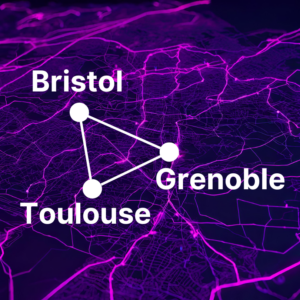 Like minds – How Bristol, Grenoble and Toulouse compare:
The tech hubs of Grenoble and Toulouse both share similarities with Bristol (one of the UK’s top five tech hubs). In the case of Grenoble and Bristol, both cities foster strong university-industry partnerships, prioritise sustainability, and are leaders in materials innovation. In the case of Toulouse and Bristol, both cities are centres of excellence for aerospace, robotics, and engineering, thanks to their universities and the strong ties to industry partners like Airbus. And in terms of lifestyle Grenoble, Toulouse and Bristol are youthful, energetic and, thanks to close proximity to nature, they offer a high quality of life.
Even though the majority of investors are based in Paris, the regional hubs that include research organisations, universities and large innovation-led corporations offer ideal incubation-like conditions for many start-ups, including:
Looking ahead, France is poised to remain at the forefront of materials science through an emphasis on AI-driven materials discovery, integration with emerging digital fabrication technologies such as robotics and 3D printing, and collaboration with leading research centres worldwide.
Main Image credit: MINATEC, Grenoble – attribution Toshihiro Matsui, CC BY-SA 3.0, via Wikimedia Commons
Founder and Managing Partner at Digital DNA a consultancy practice that helps businesses innovate, adapt and thrive. Advises startups, Bristol innovations and the venture studio Gravitywell. Founder of TechSPARK and The SPARKies.